
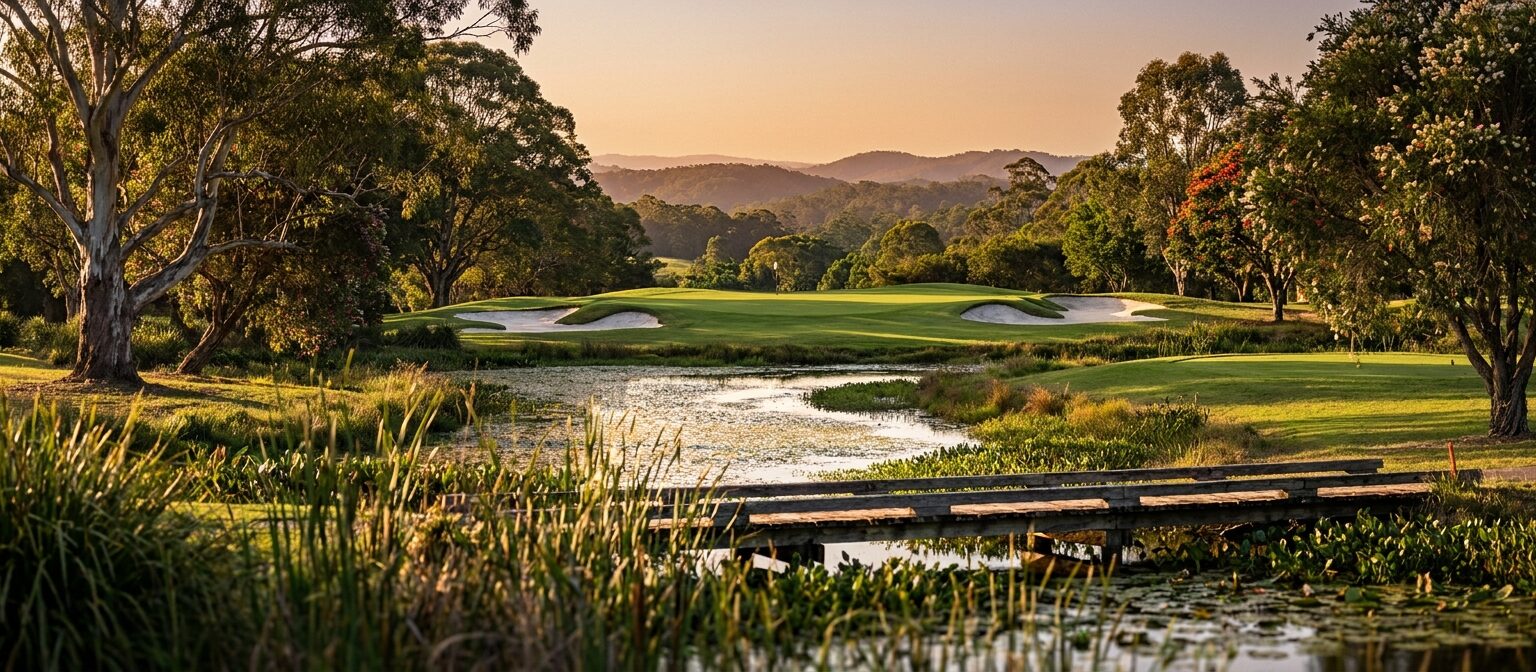
Arundel Hills Country Club sits in the rolling hinterland 10 kilometres inland from Surfers Paradise on the Gold Coast in Queensland. The 1989 Karl Litten design opened as a private-membership country club at the front-edge of the Gold Coast residential golf boom — the same wave that produced Royal Pines, Hope Island and the Robina Woods cluster over the same five-year period.
Karl Litten, the American architect who designed the project, was best known internationally for his work at the Emirates Golf Club in Dubai (1988), Lake Nona in Orlando (1987) and the original 18 at Doral’s Blue Monster (with Dick Wilson, restoration consultancy). The Arundel Hills brief was a residential-development course intended to anchor a 220-lot estate on its southern boundary, with the country club itself intended as the social hub for the residential community. The clubhouse, designed by Brisbane architect Norman Sims, opened with the course in October 1989 and has remained intact through every subsequent ownership change.
The Litten 1989 routing plays to 6,055 metres (6,628 yards) at par 72. The land has more topographic variation than most Gold Coast hinterland sites — fairways move across rolling sub-tropical eucalyptus ridges, with three wetland systems crossing the property and providing the strategic water hazards on the par-3 8th, par-4 14th and par-3 17th. The par-3 17th is the consensus signature hole — 162 metres over a wetland to an angled green with a tight rear bunker that catches the over-clubbed approach.
The course turfgrass is kikuyu fairway with Tifeagle Bermuda greens — a standard Queensland conditioning combination that handles the sub-tropical summer heat without irrigation overdose. Course superintendents through the 2000s and 2010s reported one of the smallest annual irrigation budgets of any Gold Coast course, helped by the natural rainfall pattern (1,400mm annual average) and the on-site wetland storage system.
The club entered voluntary administration in October 2017 after the active membership base fell below 200, the lowest figure since the club’s founding. The residential developer attached to the southern boundary had not exercised its option to acquire the course outright in 2014 when first offered, leaving the club without the natural exit buyer. A consortium led by Gold Coast developer Will Hawes, in partnership with the architectural firm Clayton DeVries Pont, acquired the asset in March 2019 for an undisclosed sum (industry estimates AU$8-12 million).
The Mike Clayton-led redesign opened in late 2020. Clayton’s brief, agreed with the new ownership, focused on widening five of the tightest fairway corridors (the 3rd, 9th, 11th, 14th and 17th), reducing total bunkering from 64 to 41 (a sandbelt-style consolidation that reduced maintenance overhead by an estimated 12 percent), and reshaping the greens on the 7th and 16th to remove sections that had been functionally unusable in the original Litten design. The Clayton work was the same architectural firm responsible for the Royal Melbourne West and Peninsula Kingswood restorations and is widely regarded as the most-respected of the current Australian architectural practices.
Arundel Hills currently operates as a semi-private club. Member tee times are blocked from 7:00am-10:30am weekdays and 6:30am-10:00am weekends; outside those windows the course is available to public play at AU$110 weekend / AU$85 weekday. The active membership base sat at approximately 385 as of late-2025, the highest since 2003. A second-stage redevelopment of the practice facilities, short-game area and clubhouse interior is scheduled to begin in late 2026.
The Queensland PGA Championship was held at Arundel Hills three times in the 1990s — 1993, 1996 and 1999 — won respectively by Wayne Riley, Stuart Appleby and a young Robert Allenby. None of those championships were televised; the only surviving footage is held in the Queensland PGA archive at Sanctuary Cove. The course record of 64 was set by Stuart Appleby in the second round of the 1996 Queensland PGA.