
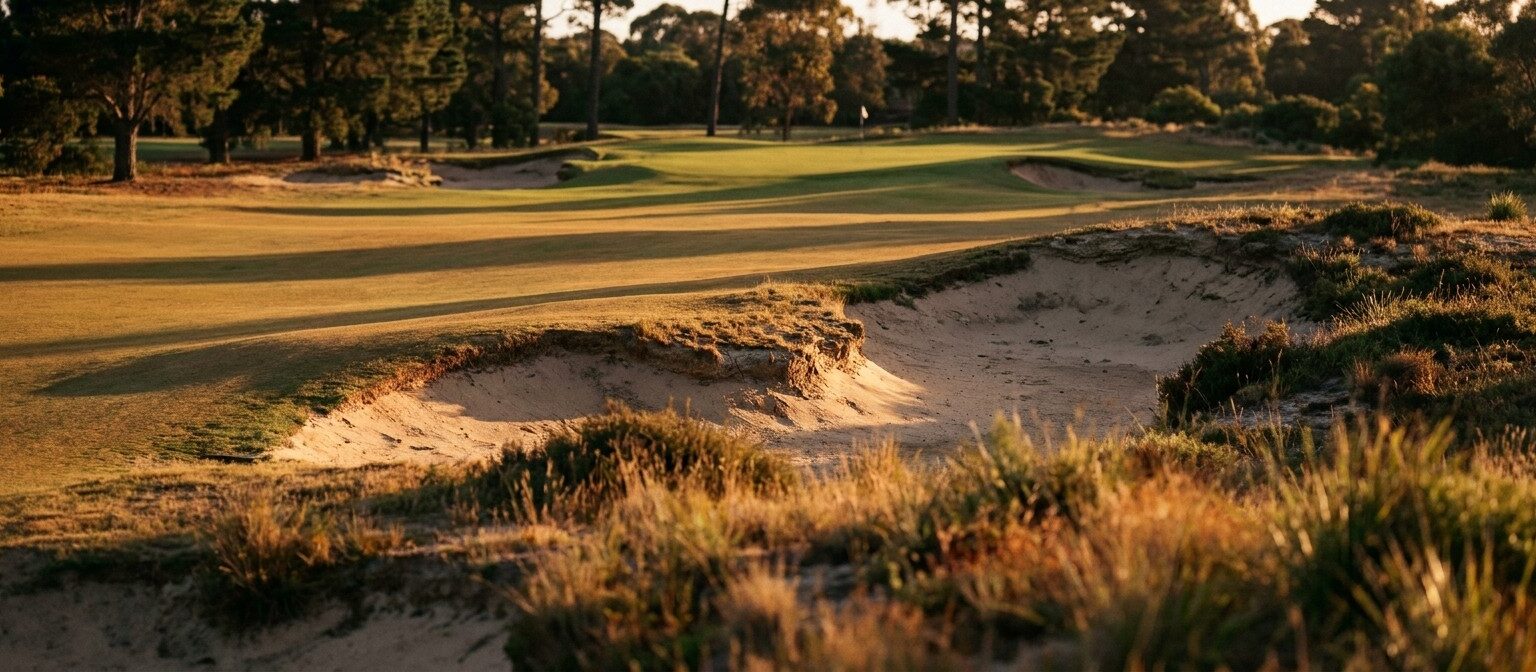
The Royal Melbourne Composite Course is the most-decorated routing in Australian championship golf — a 12-hole-from-the-West, 6-hole-from-the-East selection assembled by Alex Russell in the 1950s for international team play. The Composite has stood, with minor variation, as the venue for every major team event the club has hosted since the 1959 World Cup of Golf.
The two parent courses — the West (1931) and the East (1932) — were both designed by Alister MacKenzie during his 1926 Australian tour and supervised through to construction by his Australian deputy Alex Russell. MacKenzie’s 1926 visit produced the original routings; Russell, who later became one of Australia’s first home-grown architects in his own right, was responsible for the construction supervision and the post-MacKenzie refinements that established the courses in their current footprints. MacKenzie himself never returned to Australia after 1926; his correspondence with Russell through the late 1920s, held in the Royal Melbourne archive, is one of the most complete extant records of MacKenzie’s architectural thinking.
The Composite Course was assembled in advance of the 1959 World Cup of Golf — the first major international tournament hosted in Australia — to address the routing problem that the West course’s 11th and 12th holes crossed a public road and could not be safely used for spectator events. Russell’s solution was to splice in six holes from the East to create an 18-hole circuit that stayed entirely within the contiguous Royal Melbourne property. The selected holes — East 1, East 2, East 3, East 17, East 18, plus one routing variation — have proven so successful that no subsequent revision of the Composite has been seriously considered.
The Composite has hosted three Presidents Cups (1998, 2011, 2019), four World Cups of Golf (1959, 1972, 1988, 1998), the 1972 World Amateur Team Championship, and a long series of Australian Masters from the 1980s through 2009. Tiger Woods won the 2009 Australian Masters on the Composite, his only Australian victory and the highest-rated golf telecast in Australian Channel Nine history.
The par-4 6th from the West course — a slight dogleg with the most-photographed cross-bunker on the Sandbelt — is the consensus signature hole of the Composite and is regularly cited in international architectural rankings as one of the ten best par-4s in world golf. The bunker complex that fronts the green, a MacKenzie original retained essentially unchanged through every subsequent restoration, is the most-imitated bunkering style in the entire Sandbelt school.
The Composite plays to 6,475 metres (7,079 yards) at par 72 in its full championship configuration. Its principal defence is firmness — the Sandbelt soil generates ball roll-outs that no other parkland championship venue in the southern hemisphere matches, with greens that run hard and fast for nine months of the year. Stimpmeter readings during the 2019 Presidents Cup ran at 13.0-13.4 throughout the four-day event.
Royal Melbourne is a private member club. The Composite is set up for member play only on the days before and after major championships; otherwise members and reciprocal visitors play either the West or the East course in their standard 18-hole configurations.